


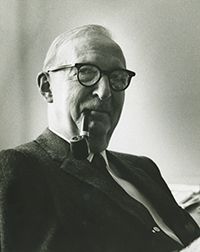
Glenn R. Morrow (1892-1973) is regarded as an outstanding Plato scholar whose focus was on political philosophy. He was a professor at the University of Pennsylvania.
In the literature on Atlantis, Morrow became known for his investigation into whether Plato is reliable when he writes about historical facts. Glenn R. Morrow’s well-known judgement was:
‘Evidently Plato knew what he was writing about. Our survey has failed to show any important instances in which Plato has distorted facts in the interests of theory. In most cases he relies on traditions generally accepted, or accepted by the most competent of his contemporaries; and when he departs from these generally accepted traditions, he is moved by critical considerations that were decisive also for Aristotle.’ (Morrow (1960) p. 72)
His judgement culminated in the famous statement about ‘Plato’s loyalty to history’. (Morrow (1960) p. 72)
In January 2026, I discovered a reference in footnote 952 on p. 352 of Beate Fränzle’s work ‘Solons Götter – Platons Theologie’ indicating that Glenn R. Morrow had – again in a footnote – made an explicit statement about Plato’s Atlantis, namely in favour of its existence!
Glenn R. Morrow first discusses Plato’s plan in the dialogue ‘The Laws’ to found a new city on the island of Crete and why Plato wanted to found this city in Crete in particular:
‘In spite of its lack of political and cultural importance in the classical period, Plato as well as his countrymen had a lively memory of the island’s former glories, of the vast power that Minos, the ancient king, once exerted over the Hellenic Sea, and of the many respects in which Crete had contributed to Greek culture in the archaic period. ... ... ... Whether facts or fancies – and we are now beginning to realize that there is usually a basis of fact beneath the fancies – these stories and beliefs indicate the hold that the great island held on the imagination of the Greeks of historical times.’(Morrow (1960) pp. 17-18)
Up to this point, Morrow has not yet discussed Atlantis, but here he adds a footnote and reveals himself to be a supporter of K.T. Frost’s Atlantis hypothesis:
‘It has been plausibly suggested by Frost, 'The Critias and Minoan Crete,' in JHS XXXIII, 1913, 189-206, that in the legend of Atlantis the glories of the ancient Cretan empire of the sea exerted their spell over Plato without his knowing the source of the enchantment. Plato says in the Timaeus that Solon got this Story from the priests of Egypt and planned to write an epic on the theme. Now it is possible that Plato was stating a fact, not a fiction, and that this uncompleted work was known to him and was the basis of his famous legend. Except for the location of Atlantis beyond the pillars of Hercules, the details in the Atlantis story fit perfectly the [p. 19] geographical position of Crete and the power of Cnossos over the adjacent islands. The story preserved in the Egyptian records would of course be an account from the Egyptian point of view. What the nonseafaring Egyptians of that period would describe as an attack from the far west or from the ends of the world would hardly seem so to the Greeks of Solon’s day, to whom Crete was nearer the southern than the western extremity of their world; hence the displacement of the mythical islands beyond the pillars of Hercules. The sudden and complete destruction of the Minoan power, a fact now attested by the archaeologists, and its disappearance henceforth from Egyptian knowledge might well have seemed like a physical catastrophe, the subsidence of the island into the sea, as it is described in the tale told by Solon. See also W. Brandenstein, Atlantis, Vienna, 1951, for a similar hypothesis.’(Morrow (1960) pp. 18 f. footnote 8)
With these statements, Glenn R. Morrow has unambiguously shown himself to be open to Atlantis as a real place. He supports K.T. Frost’s Atlantis hypothesis, considers a tradition from Egypt to be realistically possible, and refers to the work of Wilhelm Brandenstein, who was also a clear Atlantis supporter.
Morrow later reiterates these thoughts in the main text of the book, rather than in a footnote:
‘It is Solon to whom Plato attributes one of his most genial creations, the story of the empire of Atlantis and of the heroic defense put up against it by the empire of ancient Athens. It is quite possible, as I have said, that this story is in fact not a free creation, but a tradition about Solon preserved in Plato’s family which he accepted and used without being fully aware of the historical truth that underlay it.’(Morrow (1960) p. 80)
In contrast, Morrow calls Plato’s statements about primeval Athens ‘obviously the product of imagination’ (Morrow (1960) p. 90), very much in line with K. T. Frost, who wrote the famous sentence:
‘The whole description of the Athenian state in these dialogues seems much more fictitious than that of Atlantis itself.’
Finally, Morrow writes: The victory of primeval Athens over Atlantis ‘is obviously but a prehistorical replica of the Athenian victory over the Persians’ (Morrow (1960) p. 91). He also points out that the victory of primeval Athens over Atlantis is the victory of a land power over a sea power (Morrow (1960) p. 98).
Glenn R. Morrow clearly belongs to the camp of Atlantis supporters. He is one of a long line of scientists who have identified the Minoan civilization as a possible and realistic candidate for Atlantis as a real place.
One question remains: I have been studying Plato’s Atlantis for around 25 years, and yet it was only by chance that I discovered that Glenn R. Morrow was an Atlantis supporter. How can this be? The answer is simple: both Atlantis supporters and Atlantis sceptics have not done their homework. The Atlantis sceptics, mostly established scientists, believe that they can simply ignore such influential voices that oppose their opinion. So they remain silent about Morrow. But of course, such an approach has nothing to do with science. And the Atlantis supporters often do not work at a scientific level and have a negative bias against science, so they do not bother to study the literature.
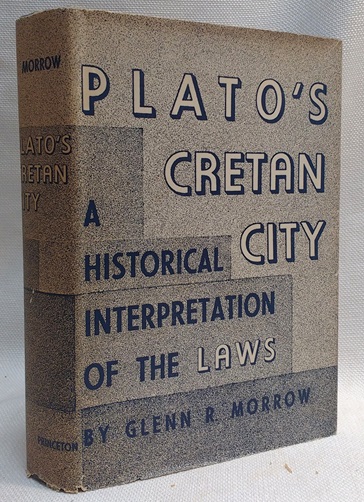
Morrow (1960): Glenn R. Morrow, Plato’s Cretan City – A Historical Interpretation of the Laws, Princeton University Press, Princeton 1960.
Fränzle (2025): Beate Fränzle, Solons Götter – Platons Theologie. Mit einem Anhang: Zur Rezeption der sogenannten Kataklysmen-Theorie (Aristoteles, Cuvier, Platon), Volume 30 of the series: Flensburger Studien zu Literatur und Theologie, edited by Markus Pohlmeyer, published by IGEL Literatur & Wissenschaft, Hamburg 2025.