


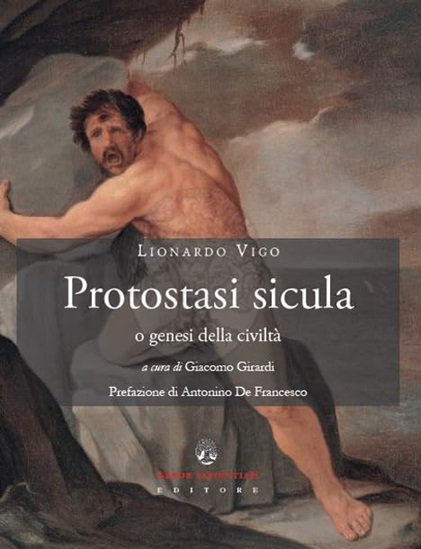
The Sicilian lawyer and amateur scholar Lionardo Vigo Calanna (1799-1879), Marchese di Gallodoro, is regarded as the founder of Sicilian folklore studies, primarily on account of his work Canti Popolari Siciliani, published in 1857. He also championed the revival of the Accademia dei Zelanti, founded in 1671, in his home town of Acireale, where his estate is still preserved today. As a fervent local patriot, Vigo opposed any form of foreign rule over Sicily, whether by the Bourbons in Naples or, later, by the government of a unified Italy in Rome, although he supported the unification of Italy in principle. His ideal was the Sicilian Constitution of 1812, which the Bourbon King Ferdinand had granted to the Sicilians under pressure from the British after fleeing from Naples to Sicily to escape Napoleon; it remained in force only until 1816. In 1848, Vigo was a member of the revolutionary parliament in Palermo.
In 1858, Lionardo Vigo began writing his work Protostasi Sicula o Genesi della Civiltà (translated: Sicilian Primacy or the Genesis of Civilization), which he essentially completed in 1864 but never had printed. In 1897, a wider public became aware of this work through Giambattista Bertazzi’s biography of Vigo, which summarised its contents over 14 pages. However, it was not until 2017 that the work was edited, annotated and published by Giacomo Girardi, with the support of Antonino De Francesco and the Accademia di Scienze, Lettere e Belle Arti degli Zelanti e dei Dafnici – as it is now known – in Acireale. (Vigo (1858 ff./2017) p. xx, p. 8; Bertazzi (1897) pp. 402 ff.; cf. Ciardi (2026) p. 194)
For Lionardo Vigo, Plato’s Atlantis was a real place. Against the proponents of the invention thesis, who sought to cloud our senses with allegories, Vigo put forward a lively argument that presents several sound points and can still inspire sympathy today (Vigo (1858 ff./2017) pp. 6, 90-92).
Lionardo Vigo situated Plato’s island of Atlantis in the western Mediterranean (Vigo (1858 ff./2017), pp. 8, 10, 20 f.). In doing so, he consistently based his argument on the more limited geographical understanding of very ancient times (cf. e.g. Vigo (1858 ff./2017), p. 5). The Strait of Gibraltar did not even exist at that time, and nobody knew anything about the Americas either. The islands of Sicily and Malta, as well as the surrounding smaller islands, are repeatedly cited as the remains of the sunken Atlantis (Vigo (1858 ff./2017), pp. 9, 20 ff., 61). Atlantis is said to have extended northwards into the Tyrrhenian Sea and southwards towards Africa; however, unlike in Delisle de Sales’ depiction, Sardinia and Corsica were not part of it (Vigo (1858 ff./2017) pp. 58, 87). Africa was interpreted as the opposite continent from the Atlantis story (Vigo (1858 ff./2017) p. 10). Vigo also discussed the meaning of the Greek words pelagos, Okeanos and thalassa (Vigo (1858 ff./2017) pp. 12-19). In doing so, he concluded that the sea to the west of Sicily was referred to as Okeanos, whilst the sea to the east of it was called pelagos (Vigo (1858 ff./2017) pp. 20, 62). The main city of Atlantis is repeatedly described as having sunk (Vigo (1858 ff./2017) pp. 54, 58, 202); it was therefore not located on Sicily or Malta, but at an unspecified location that now lies beneath the sea. Atlantis is said to have been submerged as a result of the breaching of the straits at the Maeotis Sea (Sea of Azov) and at the Dardanelles (Bosphorus), which subsequently also led to the breaching of the Strait of Gibraltar (Vigo (1858 ff./2017) pp. 54 ff.).
Strictly speaking, Lionardo Vigo did not equate the island of Sicily with Atlantis, even though his political focus was entirely on Sicily. For Vigo, Atlantis was a much larger island, of which Sicily was indeed a part, but whose main settlement was not located on present-day Sicily. For Vigo, therefore, Sicily was merely a peripheral part of Atlantis. This theory is reminiscent of the theory put forward by Axel Hausmann in 2000, who believed that Atlantis was the large island that would emerge if the sea level of the Mediterranean were to drop significantly (Hausmann (2000)). Axel Hausmann believed that the capital of Atlantis was situated on the so-called Malta Plateau around 3500 BC, that is, exactly between Malta and Sicily.
Chronologically, Lionardo Vigo remains firmly rooted in a biblical perspective. Like James Ussher, he dated the origin of humankind to 4004 BC. The Great Flood occurred in 3617 BC, the Flood of Deucalion in 1541 BC and the Flood of Dardanus in 1480 BC (Vigo (1858 ff./2017) pp. 181-185). Vigo situated the civilisation of Atlantis between the Great Flood and the Flood of Dardanus, the latter also marking the downfall of Atlantis (Vigo (1858 ff./2017) pp. 59, 67).
Lionardo Vigo believed that Atlantis was the cradle of civilisation for the whole of humanity. Vigo wished to draw a strict distinction between this and the place of origin of humanity (Vigo (1858 ff./2017) p. 4). The Atlanteans were identical to the Pelasgians, which is why Vigo repeatedly used the adjective ‘atalanto-pelasgo’. After the Great Flood, it is said that people everywhere were completely devoid of culture; they knew nothing of fire and were even cannibals (Vigo (1858 ff./2017) p. 65). From Atlantis, civilisation is said to have spread eastwards: first to Italy (Vigo (1858 ff./2017) pp. 93 ff.). And then ever further east, as far as ‘the Indies’, that is, the whole of Asia, with Bacchus playing an important role (Vigo (1858 ff./2017) pp. 28, 44, 172 ff.). For these theories, Vigo relied heavily on Diodorus Siculus (Vigo (1858 ff./2017) pp. 28, 174; Diodorus I 19, III 60, 63 ff.).
According to Vigo, the Sicani were Atlanteans who had survived the sinking of Atlantis in the mountains of the sinking island, that is to say, on the remaining islands (Vigo (1858 ff./2017) pp. 70, 193, 202). The Siculi, too, were regarded as Atlanteans, namely as emigrated Atlanteans or Pelasgians who later migrated back to Sicily (Vigo (1858 ff./2017) pp. 189, 195). According to Vigo, Plato’s account of Atlantis describes the culture of the Sicani prior to the downfall of Atlantis (Vigo (1858 ff./2017) p. 207), yet Vigo clearly failed to demonstrate the connections between Plato’s Atlantis story and the civilization of the Sicani and Siculi.
Lionardo Vigo’s description of the civilization of the Sicani and Siculi is a rather superficial and disjointed account of the well-known Sicilian myths about gods and heroes (cf. e.g. Vigo (1858 ff./2017) pp. 35-81, 127, 208) and what has been handed down by Greek authors concerning the Sicani and Siculi (cf. e.g. Vigo (1858 ff./2017) pp. 193-217). Vigo failed to establish connections between these traditions and myths and to draw fruitful conclusions, and he failed completely to identify clear links to Plato’s Atlantis story. Worse still: Vigo failed to distinguish between general Greek mythology and the specific mythology of Sicily, with the result that whilst the distinctive features of Sicily are mentioned in passing, they are entirely lost sight of and buried in a wealth of irrelevant information.
In a few places, Vigo did get something right. For example, he recognised that the Cyclopes and Laestrygonians were not a people preceding the Sicani, as Thucydides claimed, but were in fact the same people (Vigo (1858 ff./2017) p. 193). On a single occasion, Neptune is referred to as the chief god of the Atlanteans, but the statement appears more to be a retelling of Plato’s Atlantis story than a statement about the Sicani and the Siculi (Vigo (1858 ff./2017) p. 81). This insight is not repeated anywhere else in the rest of the book, even though there is much discussion of the gods of the Atlanteans. It is stated once that the first cult of Neptune was allegedly founded in Messina (Vigo (1858 ff./2017) p. 35). But no further use is made of this. Lionardo Vigo failed to demonstrate the connections between the civilization of Plato’s Atlantis and that of the Sicani and Siculi.
Vigo’s reflections did not arise in a vacuum. In the 19th century, the study of regional history prior to the Roman era became a popular pursuit in Italy, partly as a protest against an overbearing central government in Rome (Vigo (1858 ff./2017) pp. xiv, xxiii ff.). The theory that the Pelasgians were the forerunners of the Italic peoples was widespread at the time and was espoused by scholars such as Vincenzo Gioberti (Vigo (1858 ff./2017) pp. xxi f.). Finally, Angelo Mazzoldi, with his Atlantis thesis of 1840 – which posited that the Italic Pelasgians were survivors of the sunken Atlantis – was the direct predecessor of Lionardo Vigo. The difference was that Vigo narrowed down the region of the sunken Atlantis to Sicily and Malta (Vigo (1858 ff./2017) pp. xix, 9).
Lionardo Vigo made no secret of the fact that his motivation was not purely scientific. He himself set out the clear aim of demonstrating Sicily’s civilisational primacy over Italy, which was, of course, also intended to be highly political and topical (Vigo (1858 ff./2017) pp. 3 ff.). Hence the title Protostasi Sicula. The Italian word ‘protostasi’ is derived from the Greek word protostateo or protostasia, meaning ‘to stand foremost’ or ‘primacy’. The title of the work thus translates as ‘Sicilian Primacy’ and makes it abundantly clear what the author was aiming to achieve. Furthermore, Vigo challenged the prevailing view that civilization originated in the East. Instead, he sought to demonstrate that civilisation originated in the West – and, of all places, in his own homeland. Here – with all due respect for healthy local patriotism – a certain chauvinism becomes apparent, one that cannot bear the idea that civilisation is the result of a long process of development in which his own country played only a marginal role or joined in only late.
Unfortunately, we also find explicit racism in Lionardo Vigo’s work. In the context of Egypt, Vigo turned his attention to the white and black races. According to Vigo, black people have a smaller brain mass than white people. Therefore, ‘the whites are teachers and rulers; the blacks are subject to us.’ (Vigo (1858 ff./2017), p. 144; original: "Da cui i bianchi docenti ed imperanti, i neri a noi sottoposti.") This is more than just the ‘background racism’ that was common at the time; it is a very overt and direct form of racism, which is likely to have attracted criticism even back then. At least Vigo did not link this racism to Atlantis and its cultural influence extending as far as Asia. There is no other racist passage apart from this one. At most, one could interpret the list of peoples who emerged from the biblical Ark in the Caucasus as a racist statement: according to Vigo, Indians – that is, Asians – Native Americans and Europeans emerged from the Ark (Vigo (1858 ff./2017) p. 173). However, there is no mention of Africans.
One might call Lionardo Vigo a ‘Sicilian Ignatius Donnelly’, who expressed his political and cultural views through his conception of Atlantis. However, Donnelly would have taken a firm stand against the racism evident in Vigo’s work.
Bertazzi (1897): Giambattista Grassi Bertazzi, Lionardo Vigo e i Suoi Tempi, Cav. Niccolò Giannota Editore, Catania 1897.
Ciardi (2026): Marco Ciardi, Atlantide dalla scienza alla cultura di massa: riflessioni e nuovi documenti, in: Valentina Monateri / Rebecca Penna (eds.), Atlantide, Atlantidi: Dal mito platonico all’ invenzione di mondi fantastici, proceedings of the International Conference "Atlantide, Atlantidi. Dal mito platonico all'invenzione di mondi fantastici", 20./21. November 2024 Turin Aula Magna Liceo Gioberti, Vol. 120 of the series: Hellenica, Edizioni dell' Orso, Novi Ligure (Alessandria, Piemont) 2026; pp. 185-204.
Franke (2016/2021): Thorwald C. Franke, Kritische Geschichte der Meinungen und Hypothesen zu Platons Atlantis – von der Antike über das Mittelalter bis zur Moderne, 2nd edition, 2 volumes, published by Books on Demand, Norderstedt 2021. First edition was 2016.
Hausmann (2000): Axel Hausmann, Atlantis – Die versunkene Wiege der Kulturen, published by BoD, Norderstedt 2000.
Vigo (1858 ff./2017): Lionardo Vigo, Protostasi Sicula o Genesi della Civiltà, edited by Giacomo Girardi, presented by Giuseppe Contarino, preface by Antonino De Francesco, Arbor Sapientiae Editore, Rome 2017.