


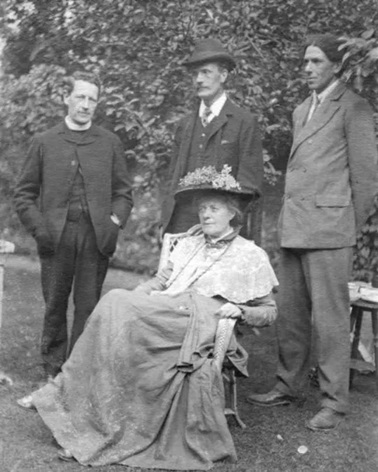
Jane Ellen Harrison (1850-1928) was a classical archaeologist and classicist. She was one of the first female academics in England. From 1898 to 1922, she was a lecturer at Newnham College, Cambridge University.
In her scientific work, Jane Harrison dealt with the topics of religion, cult and ritual, focusing on the interpretation of images preserved on vases and coins. Her works were widely received and strongly influenced the science of her time. Jane Harrison was a widely recognised authority in her field during her lifetime. She is considered part of the school of the so-called ‘Cambridge Ritualists’.
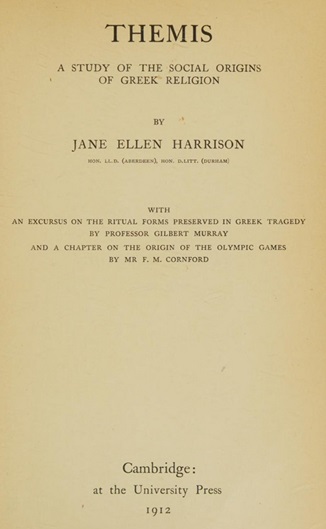
In one single passage of her extensive work, Jane Harrison gave us a clear insight into what she thought about Plato's Atlantis. On p. 163 f. of her 1912 work Themis – A Study of the Social Origins of Greek Religion, she discussed the ritual of the bull cult in Plato's Atlantis, and on p. 164 she wrote:
"It has been happily suggested that the lost island of Atlantis reflects the manners and customs, the civilization generally, of Crete, which after its great Minoan supremacy sank, for the rest of Greece, into a long oblivion. It is also very unlikely that Plato would invent ritual details which in his day would have but little significance. But we have definite evidence that the ritual described is actual, not imaginary, though this evidence comes not from Crete but from another region of the 'Mycenaean' world. The coin of Ilium ... shows, I think, very clearly, how the bull was sacrificed. The human-shaped goddess Athena Ilias is there with her fillet-twined spear and her owl; but to the right is an older sanctity, a pillar on to which is hung a bull. He will be sacrificed, not on the pillar's top, which would be extremely awkward, but with his head and his throat to be cut against the top, alongside of it, down over it (katà koryphèn)."
To the mentioning of Crete being reflected in Atlantis, Harrison added this footnote:
"See an interesting article The Lost Continent in the Times for Feb. 19, 1911."
It is obvious that Harrison was pointing here to K.T. Frost's anonymously published article The Lost Continent, which appeared on 19 February 1909 (not 1911).
We have to read these few but meaningful words very carefully. First, Harrison welcomed ("happily", "interesting") the Atlantis hypothesis from K.T. Frost. Then, she spoke out against the idea that Plato "invented" the ritual. She emphasized this by putting the word invent in Italics. Finally, Harrison added an archaeological evidence, a coin, that such rituals actually existed in the 'Mycenaean' world. The word 'Mycenaean' was put in apostrophs by her, because the coin itself is, of course, from later times. The silent assumption is that the ritual depicted on the coin goes back to Mycenaean times.
We are not allowed to draw too much from these words. It is not a forgone conclusion that Harrison entirely supported the Atlantis hypothesis of Frost. But what becomes quite clear is that Harrison was against the idea that Plato's Atlantis bull ritual was a mere invention. Harrison strongly assumed that Plato drew on historical sources. This is the core of her statement. Therefore she welcomed Frost's hypothesis.
Whether Plato drew on historical sources as puzzle pieces for a constructed story, or whether Plato drew on historical sources with the belief that the entire Atlantis story is more or less true, is not said by Jane Harrison. But we can at least ascertain a certain openess towards the latter idea, since Harrison clearly welcomed the hypothesis of K.T. Frost without any reservations. Also applying the idea of "sinking into oblivion" to Crete, as a parallel to the sinking of Atlantis, at least indicates that Harrison was very open to discuss Crete as the real Atlantis.
So, Jane Harrison was at least open for a discussion of Crete as the real Atlantis, and she was clearly against the idea that Plato wrote the Atlantis story by simple invention.
Jane Harrison touched upon the topic of Plato's Atlantis several times in other works. But the statements never allow to draw any deeper conclusion on her opinon. There are e.g. several statements about Plato's description of primeval Athens. Or, Harrison called Arthur Evans' Minoan Crete playfully "his new Atlantis".
But what we can say, is, that – though Harrison touched upon the topic several times – she never expressed any reservations against the reality of Atlantis, as modern scholars would hasten to do. That Harrison never felt urged to add a word of reservation against the reality of Plato's Atlantis is in itself a very speaking statement.
The ideas of the "Cambridge Ritualists" have been critized a lot over the years. In her book The Invention of Jane Harrison, published in 2000, Mary Beard criticizes that Jane Harrison was focused too much on pictures and images and made free associations between pictures and images. Too free associations, according to Mary Beard, who talks of "flights of fancy". For Beard, Harrison acted rather like an art historian. The example put forward by Mary Beard is the above-cited Atlantis passage (p. 106).
This criticism might or might not be generally justified. But the question has to be asked whether the example put forward by Mary Beard is a good example for her case. The similarities between Minoan / Mycenaean rituals and Plato's bull ritual in Atlantis are striking and have been observed as striking similarities by many scholars for good reasons.
Maybe, Mary Beard thought that putting forward an example touching upon the topic of Atlantis would be exceptionally ridiculous and therefore most suitable to support her case against the "Cambridge Ritualists"? If this was Mary Beard's intention, and it strongly seems so, then this would be another example, of so many examples, that the dogmatic assumption of Atlantis being an invention leads to invalid conclusions. For there is nothing ridiculous or wrong with the idea of Atlantis as a real place. And these wrong conclusions spill over into the entire field of Classics scholarship and are destroying step by step the quality and the validity of this science.
What we also should not forget is that Mary Beard herself represents an often very one-sided view of history. Making no secret of her political affiliations to the political Left, Mary Beard more often than not uses her influence as a popular scientist to support the political views preferred by her. There are not only "Cambridge Ritualists", there are also "Mary Beard Ritualists", so to say, and the truth may be found beyond these factions.
Harrison (1912): Jane Ellen Harrison, Themis – A Study of the Social Origins of Greek Religion, with an Excursus on the Ritual Forms Preserved in Greek Tragedy by Professor Gilbert Murray and a Chapter on the Origin of the Olympic Games by Mr F.M. Cornford, University Press Cambridge, Cambridge 1912.
Frost (1909): Anonymous (K.T. Frost), The Lost Continent, in: The Times (London) 19 February 1909; p. 10.
Beard (2000): Mary Beard, The Invention of Jane Harrison, Harvard University Press Cambridge/Massachusetts and London 2000.