


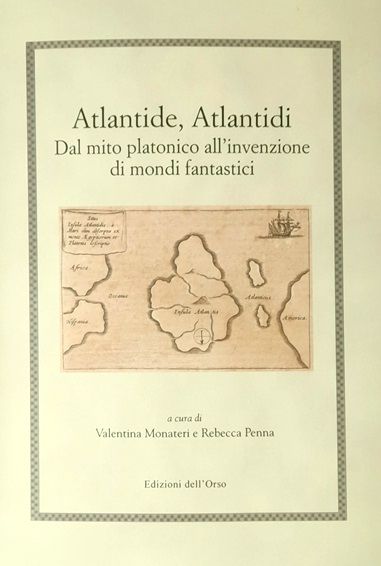
The Book of Proceedings, published 2026 |
Listen to an audio debate
|
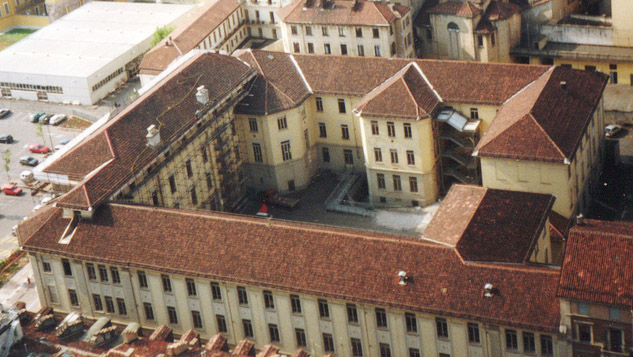
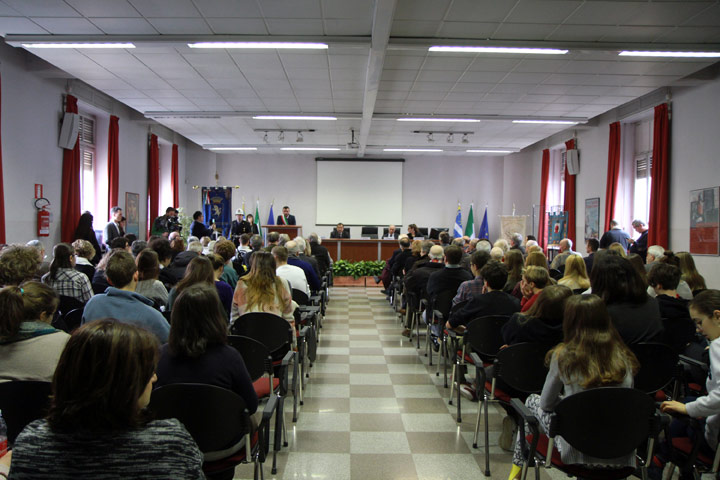
Unnoticed by the public, an Atlantis Conference has taken place in 2024. It was on the 20th and 21st of November 2024, when a dozen of international scholars (mostly Italian and German) gathered in the Aula Magna, the great hall, of the renowned Liceo Vincenzo Gioberti in Turin in Italy. The title of the conference was in Italian: "Atlantide, Atlantidi. Dal mito platonico all'invenzione di mondi fantastici", which translates to: "Atlantis, Atlantises. From the Platonic Myth to the Invention of Phantastic Worlds".
As can be seen from the title, this was a conference of academic Atlantis sceptics. But it was an Atlantis conference nevertheless. And a very interesting one. Don't disdain it! What Atlantis sceptics produce is often valuable knowledge, which is still partly valid under the different perspective of Atlantis as a real place.
But there is more to this conference, as can be seen from the proceedings published in 2026: Several of the contributions turn out to be explicit or silent answers to the theses of the Atlantis supporter Thorwald C. Franke. It seems that the Atlantis sceptics have started to realize that they are seriously challenged by Thorwald C. Franke.
This can be seen from various contributions to this conference:
Heinz-Günther Nesselrath is directly answering to Thorwald C. Franke's works "Aristotle and Atlantis" and "Kritische Geschichte der Meinungen und Hypothesen zu Platons Atlantis". Professor Nesselrath acknowledges here for the first time in an academic publication that Thorwald C. Franke was successful in undermining the idea that Aristotle certainly is the author of the invention statement in Strabo 2.3.6 ("Its inventor caused it to disappear, just as did the Poet the wall of the Achaeans"). And he presents here for the first time in an academic publication his idea that Eratosthenes could be the true author of this statement. – Since Nesselrath answers to a lot of theses of Thorwald C. Franke, Franke has written a commentary on Nesselrath's contribution.
Gianfranco Mosconi describes the political competition between primeval Athens and Atlantis, and comes to the same conclusion as did Thorwald C. Franke in his book "Kritische Geschichte" in 2016: While Athens keeps its constitution alive by education (paideia), Atlantis is built on the dwindling divine heritage and on swearing oaths, which does not prevent its stepwise downfall in decadence. What Franke had expressed only in a few passages is widely elaborated here, a really good contribution! (Please note that neither Franke nor Mosconi are likely to be the first ones to have this idea, but Mosconi is certainly the first one to elaborate it.)
Emilia di Rocco, too, answers directly to Thorwald C. Franke's discovery from 2016 that the Middle Ages were not silent about Atlantis. Unfortunately, Emilia di Rocco has forgotten to mention that she has taken over a lot from Franke's book. Thorwald C. Franke's has written a critical review of this contribution.
Luigi Silvano explores one aspect of the relation of the Histories of Herodotus and Plato's Atlantis. This same trace had been followed already by Thorwald C. Franke in his book "Mit Herodot auf den Spuren von Atlantis" from 2006, though Luigi Silvano, of course, delves much deeper into this one aspect. – Silvano follows Pradeau who identified Ionian word forms in Platos Atlantis story, concluding that Plato borrowed a lot from Herodotus who wrote in Ionian dialect. Yet, also the Egyptian translators were trained in Ionian dialect. Now, wenn you identify single Ionian word forms, but not entire phrases or at least word combinations as they appear in Herodotus: Does this speak more in favour of a borrowing from Herodotus, or does this rather point to the Egyptian translators?
Franco Arato writes about the famous Italian Enlightenment scholar Gianrinaldo Carli and his idea about Atlantis. It is widely known that Carli wrote about Atlantis, but see also Franke's book "Kritische Geschichte".
Cristiano Ragni researches the reception of Plato and Plato's Atlantis story in Renaissance England. Very interesting, but not entirely convincing. And he missed what Thorwald C. Franke had written on the subject. So, Ragni was not "silently answering" to Franke's book.
Chiara Lombardi discusses the reception of the Atlantis story and is therefore touching on the topic of Thorwald C. Franke's book "Kritische Geschichte". But Lombardi focuses on fiction writers and has great success to present two Italian poets who wrote exciting poems using Atlantis as their theme: Giambattista Casti (1724-1803) and Giacomo Leopardi (1798-1837). For Lombardi, it is "clear" that Atlantis is an invention by Plato. She starts her article by referring to Thomas Henri Martin who wondered in 1841 about the many Atlantis hypotheses, making Thomas Henri Martin a crown witness for her opinion. But Lombardi missed, that Thomas Henri Martin undermines the "clarity" of her opinion. For Thomas Henri Martin believed that Plato believed in the reality of Atlantis. For him, it were the Egyptian priests who had fooled Plato.
Valentina Monateri covers the literary reception of fiction writers in the 18. and 19. century, but unfortunately, she does it based on Pierre Vidal-Naquet's perspective, i.e., there is a complete blindness towards any legitimate attempt to see Atlantis as a real place. She did not see, e.g., that Jules Verne, who was not an author of pure phantasy out of thin air, but a science fiction author of possible future developments, listed in his novel "20,000 Leagues Under the Sea" several scholars who were for or against the existence of Atlantis. Jules Verne's Atlantis was not meant as an empty phantasy but as an attempt to understand what could be possible in the future, from the perspective of his time. For Jules Verne, the future discovery of Atlantis was just as realistic as the future construction of submarines. Jules Verne was inspired to write his Atlantis episode by the geologist Armand d'Avezac (1800-1875), as discussed in Franke's book "Kritische Geschichte".
Rebecca Penna delves deeper into the usage of the two Atlantis dialogues Timaeus and Critias in Late antiquity and found that the Critias was only rarely used, and if so, then to help clarifying the Timaeus. A thorough and helpful contribution!
Marco Ciardi is tracing the reception history of the Atlantis story from the 19th century until the 1930s, especially in Italy, which is very interesting. But he plays too much with the fear of racism and partly sees, or insinuates, racism as being connected to the search for Atlantis where this was not the case (Frobenius). Surprisingly, Ciardi reports no relation of the Italian fascists with the idea of Atlantis as a real place. This confirms a research result from Franke's book "Kritische Geschichte" (there for Germany). Ciardi points to the article of Giuseppe De Florentiis, which was published in 1939 in the journal "Sapere", founded in fascism and spreading popular science in the line of fascism. But what Ciardi seems to have missed is that this article expressed Atlantis scepticism. It is entertaining the idea of Atlantis as an ingenious (therefore "true") invention by Plato. Also at other places in this article, some Atlantis sceptics are mentioned as if they were Atlantis supporters. Ciardi also did not mention that Julius Evola explicitly wrote that he uses Atlantis only as a cipher, not as a reality. Though somewhat "Vidal-Naquet-esque", this is nevertheless a valuable contribution.
Federico M. Petrucci gives another variant of the interpretation of Critias, the dialogue participant, as a moronic and unphilosophical character. This erroneous idea was brought up for the first time by Warman Welliver in 1977 and is used to demonstrate that Atlantis can only be an invention (or that a certain contemporary US president is a moron like, allegedly, Critias; yes, also invention hypotheses have their contemporary backgrounds). Thorwald C. Franke will argue against this interpretation in a coming publication.
Valentina Monateri / Rebecca Penna (eds.), Atlantide, Atlantidi: Dal mito platonico all’ invenzione di mondi fantastici, proceedings of the Convegno Internazionale "Atlantide, Atlantidi. Dal mito platonico all'invenzione di mondi fantastici", 20./21.11.2024 Turin Aula Magna Liceo Gioberti, Vol. 120 of the series: Hellenica, Edizioni dell' Orso, Novi Ligure (Alessandria, Piemont) 2026.
This book of proceedings is in Italian. Different to usual academic publications, it is not expensive.
Franke (2006/2016): Thorwald C. Franke, Mit Herodot auf den Spuren von Atlantis – Könnte Atlantis doch ein realer Ort gewesen sein?, 2nd enhanced edition, Verlag Books on Demand, Norderstedt 2016. First edition was 2006.
Franke (2010/2016): Thorwald C. Franke, Aristoteles und Atlantis – Was dachte der Philosoph wirklich über das Inselreich des Platon?, zweite erweiterte Auflage 2016, Verlag Books on Demand, Norderstedt 2016. First edition was 2010. With the enhancements of the English edition and with Addenda in the appendix.
Franke (2012): Thorwald C. Franke, Aristotle and Atlantis – What did the philosopher really think about Plato's island empire?, published by Books on Demand, Norderstedt 2016. German first edition from 2010. Enhancements to the German edition in an appendix.
Franke (2016/2021): Thorwald C. Franke, Kritische Geschichte der Meinungen und Hypothesen zu Platons Atlantis – von der Antike über das Mittelalter bis zur Moderne, 2nd edition, 2 volumes, published by Books on Demand, Norderstedt 2021. First edition was 2016.